
 If you’ve put off commercial asphalt maintenance in Battle Creek for a couple of years, you’re not alone—but you’re likely seeing the consequences. From the downtown corridors near Michigan Avenue to the high-traffic lots along Columbia Avenue, we see firsthand how neglected pavement quickly goes from “a little worn” to “seriously damaged.”
Let’s break down exactly what happens when maintenance falls by the wayside for two years or more—and what steps you can take next to get your pavement back in shape.
Key Takeaways
- Cracks, potholes, and surface damage show up fast when commercial asphalt goes unmaintained for two or more years.
- Battle Creek winters, heavy traffic, and poor drainage make neglected pavement wear out much faster than expected.
- Property owners should walk their lot, watch how water drains, and talk with staff to spot early problems.
- Timely repairs and basic upkeep cost less than full reconstruction and help your lot stay safe and professional.
Surface Cracks Multiply and Deepen
After two years without sealcoating or crack repairs, even the smallest hairline cracks begin to widen and multiply.
In Battle Creek, where snow and ice linger from November into April, water seeps into these cracks, freezes, and expands, causing even more damage. We see this all the time in lots around Lakeview Square Mall and the commercial centers on Beckley Road.
Once surface cracks deepen, they invite even more moisture and debris in, accelerating the breakdown of your pavement’s foundation.
Potholes Form and Spread Fast
Once cracks are left unchecked through a couple of Michigan winters, it’s just a matter of time before potholes start popping up. And in a commercial lot, it doesn’t take long for one small pothole to become several.
Businesses along Capital Avenue and in the Fort Custer Industrial Park often deal with this after skipping pavement maintenance, especially when delivery trucks and snowplows hit weakened spots repeatedly.
Potholes don’t just look bad—they create trip hazards and potential liability issues for your tenants, employees, or customers.
Drainage Problems Get Worse
Without regular upkeep, your asphalt’s surface starts to lose its proper slope and grading.
That means water doesn’t drain the way it should.
In Battle Creek’s low-lying areas—like near the Kalamazoo River or along Dickman Road—standing water becomes a serious issue. Pooling water accelerates pavement erosion, encourages algae and moss growth, and increases the risk of icy spots in winter.
Drainage issues can also creep into surrounding landscaping, causing even more property headaches.
Faded Striping Reduces Safety and Curb Appeal
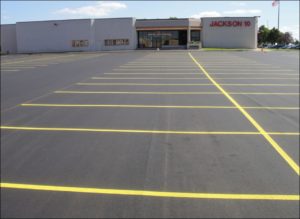
After two years without re-striping, even well-planned parking lots become confusing to navigate. We’ve worked on properties near Kellogg Community College and the Battle Creek Executive Airport, where directional arrows, ADA markings, and parking stalls have faded to the point of being barely visible.
This reduces efficiency, creates liability concerns, and sends the wrong message to clients and visitors about your business’s upkeep standards.
Weeds and Vegetation Take Over the Cracks
As cracks expand and fill with debris, seeds and dirt settle in—and weeds follow.
We’ve seen this take over entire edges of lots along M-66 and West Columbia, where the curb lines and joint cracks have gone years without maintenance.
What starts as a few dandelions quickly turns into thick vegetation that eats away at the asphalt and gives your property an abandoned look. Plus, weed roots worsen cracking, especially when they take hold in the base layer of the pavement.
Subsurface Damage Begins to Undermine the Base
The longer water and plant matter are allowed to enter your asphalt, the more damage occurs below the surface. In areas with high truck traffic—like near the I-94 Business Loop or in the Fort Custer area—this can mean base failure.
Once the sub-base is compromised, no surface repair can fully fix the problem without reconstruction. That’s where deferred maintenance really starts to get expensive, with full-depth patching or milling often required.
What to Do if You’ve Skipped Commercial Asphalt Maintenance for Over 2 Years in Battle Creek
If your pavement hasn’t seen attention in years, don’t panic—but don’t ignore it either. Here are practical steps you can take as a property owner or facility manager to start turning things around.
Walk the Entire Lot and Document Problem Areas
Start with a thorough visual inspection of your lot.
- Walk it on foot, especially around drain inlets, curb lines, and high-traffic areas like loading zones or building entrances.
- Take photos of cracks, potholes, pooling water, and faded pavement markings.
- Make notes of any areas where the pavement feels soft underfoot—that’s often a sign of base failure.
In neighborhoods like Urbandale or Post Franklin, lots with mixed-use traffic need particular attention in corner areas where pavement stress concentrates.
Check How Drainage Is Performing After a Rain
After a moderate rain, walk your property again and observe where water is collecting.
Look near catch basins, curbs, and in the center of large lots. In Battle Creek’s clay-heavy soil zones, like those near Bailey Park, poor drainage can become a hidden enemy that eats away at your pavement from underneath.
Make a note of persistent puddles or flow issues—these often indicate areas that need regrading or improved slope.
Ask Your Team About Recurring Complaints or Incidents
If you manage a commercial or multi-tenant property in Battle Creek—say, near Lakeview or Goguac Lake—it’s worth checking with your on-site staff about any recurring complaints from tenants or customers.
- Have there been complaints about uneven surfaces, standing water, or near-miss accidents?
- Any frequent issues with delivery trucks navigating the lot?
This kind of anecdotal information helps prioritize repairs based on real-world use.
Prioritize Repairs by Safety, Then Appearance
Once you have a full view of the damage, prioritize asphalt repairs based on what presents the highest safety risk. Deep potholes, loose asphalt chunks, or major drainage issues should come first.
In Battle Creek, we often recommend fixing trip hazards and drainage problems before worrying about cosmetic upgrades like sealcoating or striping.
That said, improving visual appeal is still important, especially if your business depends on foot traffic or first impressions.
Protect Your Investment Before It Costs You More
At Asphalt Solutions Plus, we specialize in helping local businesses turn neglected lots around—whether you’re off Helmer Road, near downtown, or out by Harper Village. Our team offers honest assessments, practical repair plans, and expert maintenance designed to stretch your pavement’s life and keep your property safe and appealing.
Don’t wait until you’re forced to repave.
Reach out today to schedule a site evaluation, and let’s make a plan to restore your commercial lot the right way.
Frequently Asked Questions
How often should commercial asphalt be inspected in Battle Creek’s climate?
Inspections should happen at least twice a year—once after winter and again in fall—to spot early signs of damage, drainage problems, or fading paint before they become more expensive to fix.
Can heavy snow plowing damage commercial asphalt over time?
Yes, especially when cracks or weak edges are present. The weight and scraping from plows can loosen asphalt, chip surface layers, and push moisture into the base, making springtime damage much worse.
Are commercial properties in Battle Creek required to meet specific pavement safety standards?
Yes, local code requires marked ADA spaces, smooth walkways, and safe parking conditions. Properties that don’t meet these standards risk citations, complaints, and possible legal or insurance complications.
Is asphalt maintenance for a commercial lot considered a tax-deductible business expense?
Yes, in most cases. Routine asphalt repairs and maintenance usually qualify as deductible operating costs, but always confirm with a tax professional based on your business structure and filing method.